Winter's Night Ale
Christmas is almost here, the days are short and nights are drawing in. What better time to brew a dark beer? So here we are, my attempt at an ESB-strength bitter that suits this time of year.
Starter
The yeast for this brew will be something rather special.
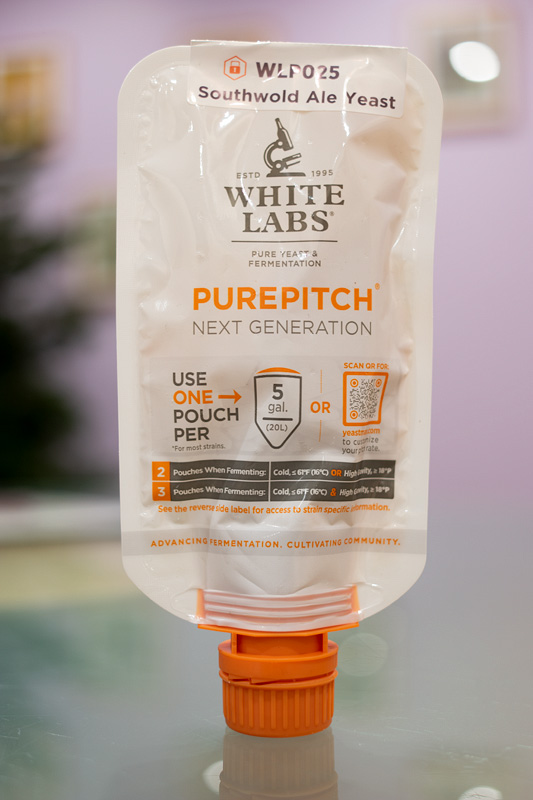
WLP025 (Southwold) is of course the Adnams strain and is a White Labs Vault release which means that they only release it if they get enough interest. I was very pleased to see it in stock at the Malt Miller and wasted no time at all in ordering myself a packet.
The Adnams strain is, famously, a dual strain consisting of one strain for flavour and one for flocculation - an important characteristic when you're brewing on a commercial scale. WLP025 is a single strain which would make it the strain responsible for flavour.
Given the super quality of Adnams ales I'm really excited to be brewing with this yeast and if it proves to be a winner then I'll keep it going for as long as it continues to perform.
Anyway, I got the starter on Tuesday evening before Sunday's brewday. As usual I made up 1.5 litres of DME-based wort of which 1 litre will go into the fermenter and the remaining half litre gets saved back in my fridge to use as the seed for the next brew's starter.
I was pleased to see that the following morning, about 10 hours later, the starter had already got a small head on it so it took off really quickly.
By that same evening the head had gone, the starter looked flat and the colour had changed to the distinctive creamy colour that you get when it's done. That was quick. I left it overnight and then separated off the 500ml for the fridge on the Thursday morning before heading off on the train to work in London.
Brew day
Here's the recipe that I decided on. It has a fair amount (6.7%) of 400 EBC crystal in it which is the darkest that I've ever used. Adnams make some excellent dark ales, e.g. Broadside, so I'm thinking that their yeast strain will cope well with this malt profile.
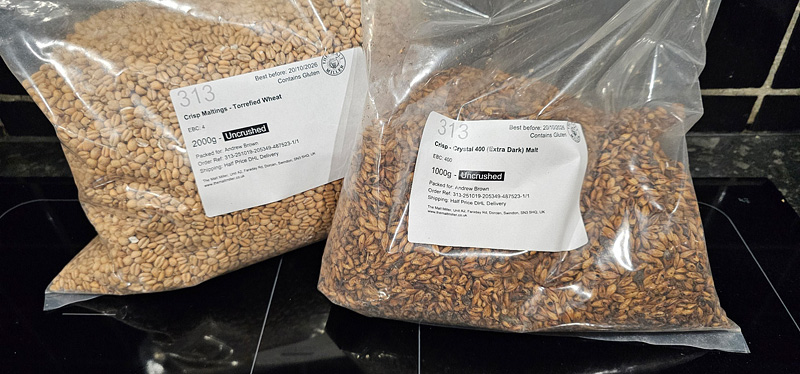
I've also included a small amount of torrified wheat to try to counteract the negative effect that dark malts have on head retention.
I decided to use Magnum for the bittering hop because it has a reputation for smoothness which I hope will balance any bitterness coming from the Crystal 400.
Flavouring comes from that classic combination of a Golding and Fuggle. I selected First Gold on purpose partly because it matches the hop used in Adnams Broadside but mainly because it's just such a lovely flavour. It has an orangey flavour that I'm hoping will provide a good balance to the sweetness of the crystal malt.
Recipe Specifications
--------------------------
Date: 20 December 2025
Batch Size (fermenter): 24.00 L
Estimated OG: 1.046 SG
Estimated Color: 26.0 EBC
Estimated IBU: 37.2 IBUs
Brewhouse Efficiency: 75.00 %
Est Mash Efficiency: 75.6 %
Boil Time: 60 Minutes
Water profile: Ca:53 Mg:10 Na:10 SO4:33 Cl:77

Ingredients:
------------
Amt         Name                                            Type          %/IBU
29.68 L     Tesco Water                                     Water         -
2.50 g      Calcium Chloride (Mash)                         Water Agent   -
2.00 ml     Lactic Acid (Mash)                              Water Agent   -
1.20 g      Epsom Salt (MgSO4) (Mash)                       Water Agent   -
4.200 kg    Crisp Clear Choice Extra Pale Malt (4.0 EBC)    Grain         89.4 %
0.300 kg    Dark Crystal (Crystal 400) (Crisp) (400.0 EBC)  Grain         6.4 %
0.200 kg    Wheat, Torrified (3.3 EBC)                      Grain         4.3 %
0.50 g      Calcium Chloride (Sparge)                       Water Agent   -
0.30 g      Epsom Salt (MgSO4) (Sparge)                     Water Agent   -
0.30 ml     Lactic Acid (Sparge)                            Water Agent   -
20.00 g     Hallertau Magnum [11.40 %] - Boil 60.0 min      Hop           25.7 IBUs
20.00 g     First Gold [8.40 %] - Boil 10.0 min             Hop           6.9 IBUs
20.00 g     Fuggle [5.60 %] - Boil 10.0 min                 Hop           4.6 IBUs
1.00 Items  Whirlfloc Tablet (Boil 7.0 mins)                Fining        -
1.0 pkg     Southwold Ale (White Labs #WLP025)              Yeast         -

Mash Schedule: Single Infusion, Full Body
Total Grain Weight: 4.515 kg
----------------------------
Name           Description                      Step Temperat Step Time
Mash In        Add 24.68 L of water at 71.3 C   67.0 C        60 min

Sparge: Dunk sparge with 5.00 L water at 75.6 C
The water I'm using has changed again since the last brew. In my write-up for that brew I complained that I had to use Elmhurst water because Ashbeck was discontinued by Tesco. Well, I've inspected the mineral content on their new 5 litre own-brand 'Tesco British Water' and lo and behold it's good old Ashbeck from Armathwaite in Cumbria so I'm back on track with a good, low mineral content bottled water as my base.
Brew day went off without any hitches and I was able to collect the usual 24 litres or so into the fermenter by midday. I checked in later at 6pm and not only had it started but the activity in the blowoff tube was a continuous stream of bubbles. This yeast is fast. I would expect to see the level of activity that I'm seeing at 6 hours after 18 hours.
Next morning I checked again and the stream of bubbles in the blow-off tube is very fast and almost violent. This is one impressive yeast that seems to get to work at breakneck speed.
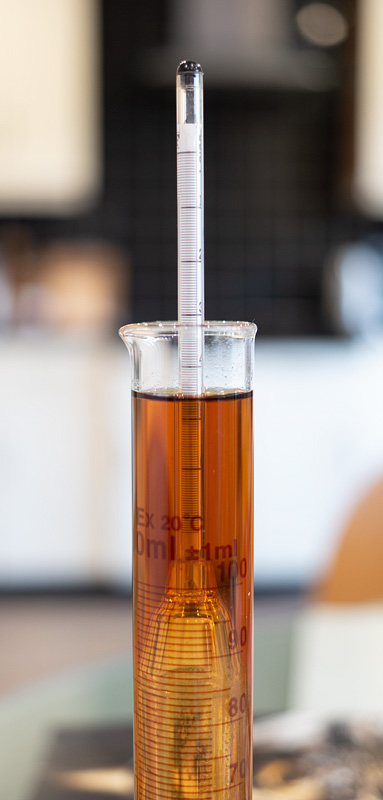
The OG was 1.046, exactly as specified by the recipe and the colour (which always looks lighter in the sample jar) shows signs that it will be a nice chestnut brown by the time it's fermented and conditioned. The sample jar tasted great, with a real rounded sweetness together with toffee flavours from the crystal malt.
Kegging day
I kegged this one after about 14 days after which the final gravity had reached 1.007.
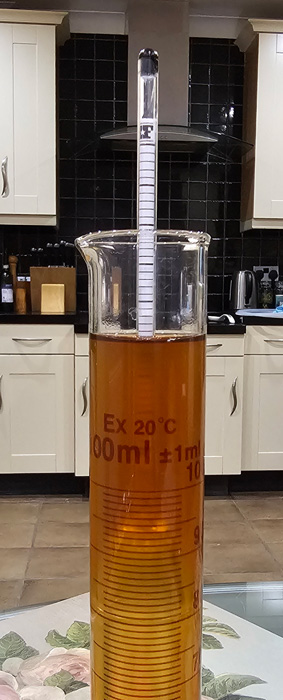
1.007 gives an ABV of 5.1% which is on the high side for me but about right for a winter ale so I'm OK with that. The sample jar was quite cloudy compared to usual but I've read that WLP025 is a powdery yeast that's easily disturbed so I'm not altogether surprised.
As usual I kegged the majority of the ale and bottled what remained.
Tasting notes
Here's an image of how it looks:
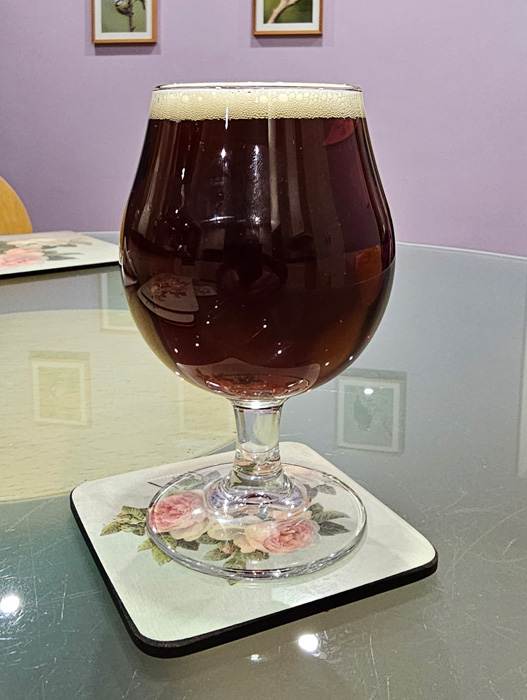
It tastes really great. I get toffee sweetness, dark fruits and an overall softness from the Fuggle hops all balanced nicely with the very smooth bitterness delivered by the Magnum hops. This, I think, will be come my regular winter brew.
Dare I say it, it also really does remind me of the Adnams ales and so this is a yeast that I will keep on re-using for many more iterations.